
Threats to the Sargasso Sea
"The Sargasso Sea is...threatened and in need of precautionary management. Human activities impact the Sargasso Sea in a variety of ways ... includ[ing] over-fishing, shipping, pollution and even exploitation of Sargassum."
"Despite its remote location in the Atlantic, the Sargasso Sea is not immune from the impacts of human activities. A recent global analysis of human impacts on marine ecosystems concluded that the Sargasso Sea has sustained moderate to high impacts over time (Halpern, Walbridge, Selkoe, Kappel, Micheli, D’Agrosa, Bruno, Casey, Ebert, Fox, Fujita, Heinemann, Lenihan, Madin, Perry, Selig, Spalding, Steneck and Watson 2008)....
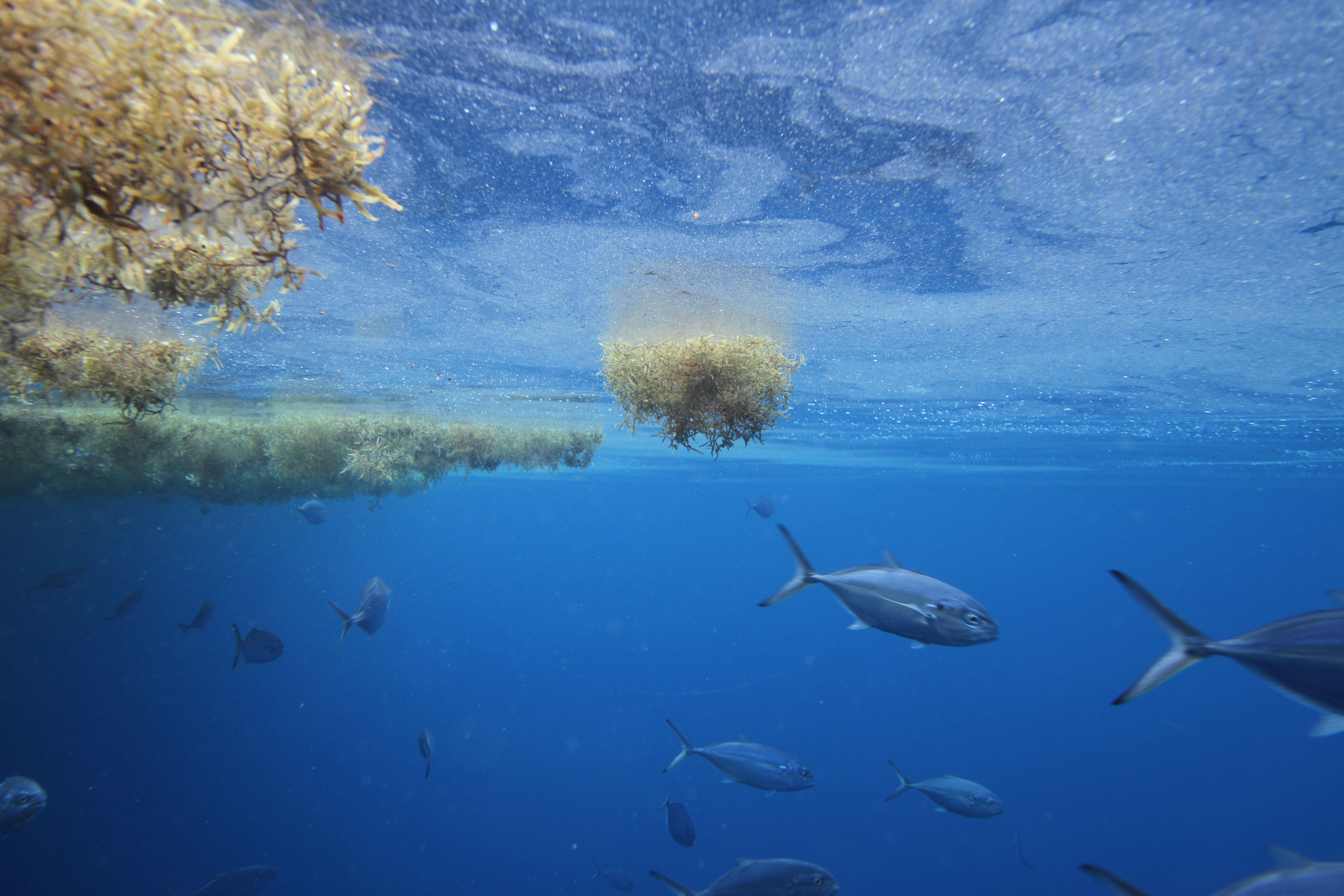 Jacks in Sargassum. Copyright Sylvia Earle
Impacts of fishing and over-fishing:
Fisheries for many key species in the North Central Atlantic, including the Sargasso Sea, have declined significantly in the last 50 years. With the exception of swordfish, all targeted tuna and tuna-like species regulated by ICCAT are now on the IUCN Red List. According to ICCAT databases, between 1950 and 2008 there have been notable changes in dominant targeted species from bluefin tuna (T. thynnus) in the 1960s, to albacore (T. alalunga), swordfish (X. gladius), and bigeye tuna (T. obsesus), in the 1970s and 1980s, to yellowfin tuna (T. albacores), in the 1990s and 2000s (www.iccat.int). ... As elsewhere, the fishery has progressed from high value bluefin tuna to fish lower down the food chain and lower in value (Pauly and Watson 2005, Pauly, Watson and Alder 2005).There is evidence that Japanese longline fishing in the Atlantic made progressively greater incursions into the eastern Sargasso Sea from 1975 through 2000 (Yokawa and Uozumi 2001), but the major country involved is now the USA catching yellowfin tuna. ...
According to ICCAT (2010), yellowfin and bigeye tuna, white marlin and blue marlin, the northern albacore, western stocks of bluefin tuna and sailfish have all been overfished in the past, and swordfish may have been. At present, the western bluefin tuna and blue marlin are still being overfished, sailfish and bigeye tuna may be being overfished, and white marlin may be being overfished but the status of this species is complicated because of confusion of this species with the roundscale spearfish (Tetrapturus georgii). Stocks of yellowfin tuna, northern albacore, skipjack tuna, and swordfish are not being overfished at present, although, with the exception of skipjack, biomass of these stocks is lower than it could be because of the historic over-fishing. Stock assessments and catch limits are in place for all of these species individually, but this is not the case for the group of miscellaneous species lumped together by ICCAT as “small tunas”. These include species like wahoo, Spanish mackerel and blackfin tuna, which ICCAT recognize are all of high socio-economic value to local fisheries. Despite their importance, there are few stock data and no management regulations in place for these species, some of which spawn in the Sargasso Sea.
In addition to direct fishing impacts on targeted species, the type of fishing gear used has potential impact upon by-catch. Approximately two thirds of the landings from the Sargasso Sea over the last decade have been from longlines (www.iccat.int). With best practice, longlining can generate low levels of by-catch compared to other commercial fishing methods (Bjordal and Løkkeborg 1996). However, other (unspecified) gear recorded as catching yellowfin tuna may include purse seines, which can take significant amounts of by-catch, particularly of juvenile and other small tunas (Amandè, Ariz, Chassot, Delgado de Molina, Gaertner, Murua,Pianet, Ruiz and Chavance 2010). The Sargasso Sea is potentially particularly vulnerable from purse-seining because nets set close to floating objects, e.g. rafts of Sargassum, take more by-catch. Lost and abandoned fishing gear can also have negative impacts.
Gill nets are still used in the Sargasso Sea and these are known to have high by-catch (Kelleher 2005). Their use for fishing for tunas and related species is limited (www.iccat.int), but they may be used by fisheries for smaller pelagic species that are not managed by ICCAT. Finally there is potentially some illegal, unregulated and unreported (IUU) fishing in the Sargasso Sea, but this has not been evaluated and recent controls on the trade in large pelagic species managed by ICCAT has reduced IUU activity targeting these species (Agnew, Pearce, Pramod, Peatman, Watson, Beddington, and Pitcher 2009, MRAG 2005).
Although the present state of the stocks of many of the species managed by ICCAT is below historical levels, ICCAT have in the past imposed time-limited closed areas and moratoria on fishing near floating objects in efforts to protect juvenile bigeye, yellowfin and skipjack. However they recognize (ICCAT 2010) that the present closed areas are too small to be very effective (and are also in an area of low fishing effort). A much more ambitious use of marine protected areas as a management tool for tuna fisheries and conservation of offshore marine pelagic ecosystems was put forward within ICCAT by Fonteneau (2007). Fonteneau discussed several potential MPAs one of which is in the North Atlantic between ca 30-430N 34-630 W and which overlaps the present area of interest in the Sargasso Sea. Clearly any moves by ICCAT to establish such large scale MPAs should be encouraged, as should more recent initiatives (ICCAT 2011c) to establish time/area closures aimed at protecting marlin. At the same ICCAT (2011c) meeting conservation measures for porbeagle sharks were tabled by both Canada and the UK Overseas Territories with the EU. No consensus was reached but again ICCAT should be encouraged to develop and implement these various conservation measures.
In addition to these fisheries, deep pelagic and bottom trawling by the USSR and Russia on the Corner Rise Seamount between 1976 and 1995 caught some 19,000 tons of fish—predominantly alfonsino, and caused extensive destruction of the benthic fauna (Vinnichenko, 1997, Waller, Watling, Auster and Shank, 2007, Shank 2010). As a precautionary management measure, 13 fishable seamounts, including 25 peaks shallower than 2,000 m on the New England and Corner Rise seamounts were closed to demersal fishing by the Northwest Atlantic Fishery Organization (NAFO) from January 1, 2007. This closure was recently extended until December 31, 2014 (NAFO 2011). Norse et al(2011) reviewed the sustainability of deep-sea fisheries and concluded that these are generally unsustainable and more akin to mining, i.e. eliminate a resource before moving on. It is not only fish that are adversely impacted by bottom trawling; corals and associated benthic faunas are destroyed and both the Corner Rise and New England Seamounts are home to numerous endemic and novel species of coral which in turn host specific commensal invertebrates (Watling 2007, Watling et al.2007, Simpson and Watling 2011, Pante and Watling 2011, ICES 2011). Resumption of trawling on these seamounts will severely degrade the habitats and pose very serious risks to their biodiversity and it is important to maintain the present prohibition.
Shipping and shipping related impacts:
The Sargasso Sea lies within one of the world’s busiest international shipping areas and is crossed by a large number of vessels each year. The full range of vessel types operate in these waters, with many following distinct routeing patterns according to the vessel type and the nature of the cargo carried (Roberts 2011, unpublished).
While it is reasonable to argue that areas having the greatest volume of ship traffic are most vulnerable to environmental impacts from this, there is little direct evidence for such impacts in the Sargasso Sea, although this may be due to lack of appropriate research aimed at defining and quantifying any such impacts (GESAMP 2009). Nevertheless taking into account the volume of shipping traffic that crosses the area each year the potential for adverse impacts certainly exists. Potential risks include the discharge of harmful pollutants e.g. sewage, oil, chemicals, and “foreign” organisms in ballast water by transiting ships (South Atlantic Fishery Management Council 2002, Halpern et al. 2008, Roberts 2011, unpublished). Further research is needed to identify and quantify any such risks. ...
Another shipping related concern is underwater noise generated by ships and the potential impact of this on those animals, especially whales and dolphins, which rely upon hearing and sound production for navigation, feeding and social interactions (Wright et al. 2009). Within the ocean, human generated background noise at the same frequencies as those used by many marine animals has increased 100-fold in some locations over the last 50 years (Wright et al. 2009). Problems caused by this increasing level of anthropogenic noise can be exacerbated by loud noises or particular frequencies that can cause death in some whales. Whilst there is no direct evidence for noise related problems in the Sargasso Sea, the high level of shipping traffic suggests that there is a high level of anthropogenic underwater noise which may be harmful to marine life. Research is needed to evaluate this.
Marine animals including birds, turtles and fish may become entangled in this plastic debris leading to choking and strangulation, or they may eat it, compromising their nutrition, and possibly exposing them to toxic chemicals in the plastics. Witherington (1994) found a high incidence of plastics, including plastic bags and strips, caulking materials and vermiculite in post-hatchling loggerhead turtles. The impact of microplastics on the marine environment has recently been reviewed (Cole, Lindeque, Halsband, and Galloway 2011), and plastic pollution in the Sargasso Sea is specifically referenced in a recent report (STAP 2011). The latter summarises the extent and increasing problems associated with marine debris especially plastics but also discarded fishing gear. “Plastic debris is unsightly; it damages fisheries and tourism, kills and injures a wide range of marine life, has the capacity to transport potentially harmful chemicals and invasive species and can represent a threat to human health”(STAP 2011). The report makes recommendations to reduce the problems.
Sargassum and its associated animal community accumulate arsenic, mercury and germanium (Johnson and Braman 1975) but we are not aware of any background data for these chemicals in the water of the Sargasso Sea. However polychlorinated biphenols (PCBs) are four times more concentrated in the water within Sargassum ‘windrows’ as compared to open ocean water (Bidleman and Olney 1974). More recently, high levels of persistent organic pollutants have been found on floating plastic resin pellets at sea, adding another level of risk when or if they are ingested by marine species (Rios, Moore and Jones 2007).
Commercial extraction:
Commercial extraction of Sargassum has the potential to pose a direct threat to the Sargasso Sea ecosystem though it is not thought to be taking place in the western Atlantic at present. In the recent past, Sargassum has been harvested on both artisanal and commercial scales for use as fertilizer and cattle feed. A management plan exists for its regulation within a portion of the US Exclusive Economic Zone, but not for the High Seas (South Atlantic Fishery Management Council 2002, McHugh 2003). With respect to international protection of Sargassum and the Sargasso Sea, the Fishery Management Plan for Pelagic Sargassum Habitat of The South Atlantic Region explicitly recommends: “Because of the importance of the extra-jurisdictional pelagic Sargassum occurring in the Sargasso Sea outside the EEZ, the United States should pursue all other options under the Magnuson-Stevens Act and other laws to protect Sargassum in international waters” (South Atlantic Fishery Management Council 2002, p. 125). There is increasing concern that the growth of new and novel uses of Sargassum weed could radically increase demand and increase pressures for large-scale exploitation and harvesting, and Lenstron, van Haal and Reith (2011) have recently proposed a scheme to harvest Sargassum in situ from artificially fertilised areas of the Sargasso Sea. A recent website search by the Sargasso Sea Alliance has revealed nearly 90 distinct patents referencing Sargassum. Various industrial, medical and nutritional uses are proposed including applications focused on inhibiting HIV infection, as an antibiotic, antifungal and antifouling substance, and as biofuel. The latter seems unlikely since many species of Sargassum-including S natans, contain antibacterial properties which will inhibit microbial decomposition and fermentation (see eg Nadal 1961, Patra,Rath,Jena,Rathod and Thatoi 2008).
The impact of potential seabed mining is another concern. Within or on the seabed there are a number of mineral resources that are potentially important including polymetallic sulphides, manganese nodules and cobalt-rich crusts, gas hydrates, and, in the thick sediment deposits in the west of the area, hydrocarbons. The commercial attractiveness of these resources depends upon the state of the industry, economic and technical considerations. None of these resources is presently exploited in the Sargasso Sea region but the potential for future mining and extraction remains. An indication of future interests is that both Russia and China have recently applied to the International Seabed Authority for exploration licenses for polymetallic sulphides in areas of the mid-ocean ridge in the Atlantic and Indian Oceans (Parson and Edwards 2011, unpublished). More directly, there are pending or future claims to some of the outer continental shelf underlying the Sargasso Sea High Seas by adjacent coastal States with corresponding rights over exploration and exploitation of mineral and sedentary resources. For example, the Bahamas has announced its intention to claim outer continental shelf beyond 200 m in the area of Blake Spur (UN, 2009).
Also on the seabed there are numerous submarine communications cables (Telegeography 2011) but the impact of these and the potential impact of any deepwater repairs to these in the Sargasso Sea is unknown.
Above is an excerpted text (pages 33-37). When referenced this report should be referred to as:
Laffoley, D.d’A., Roe, H.S.J., Angel, M.V., Ardron, J., Bates, N.R, Boyd, I.L., Brooke, S., Buck, K.N., Carlson, C.A., Causey, B., Conte, M.H., Christiansen, S., Cleary, J., Donnelly, J., Earle, S.A., Edwards, R., Gjerde, K.M., Giovannoni, S.J., Gulick, S., Gollock, M., Hallett, J., Halpin, P., Hanel, R., Hemphill, A., Johnson, R.J., Knap, A.H., Lomas, M.W., McKenna, S.A., Miller, M.J., Miller, P.I., Ming, F.W., Moffitt, R., Nelson, N.B., Parson, L., Peters, A.J., Pitt, J., Rouja, P., Roberts, J., Roberts, J., Seigel, D.A., Siuda, A.N.S., Steinberg, D.K., Stevenson, A., Sumaila, V.R., Swartz, W., Thorrold, S., Trott, T.M., and V. Vats. 2011. The protection and management of the Sargasso Sea: The golden floating rainforest of the Atlantic Ocean. Summary Science and Supporting Evidence Case.Sargasso Sea Alliance, 44 pp. Click here to download full report PDF which includes figures mentioned above.