
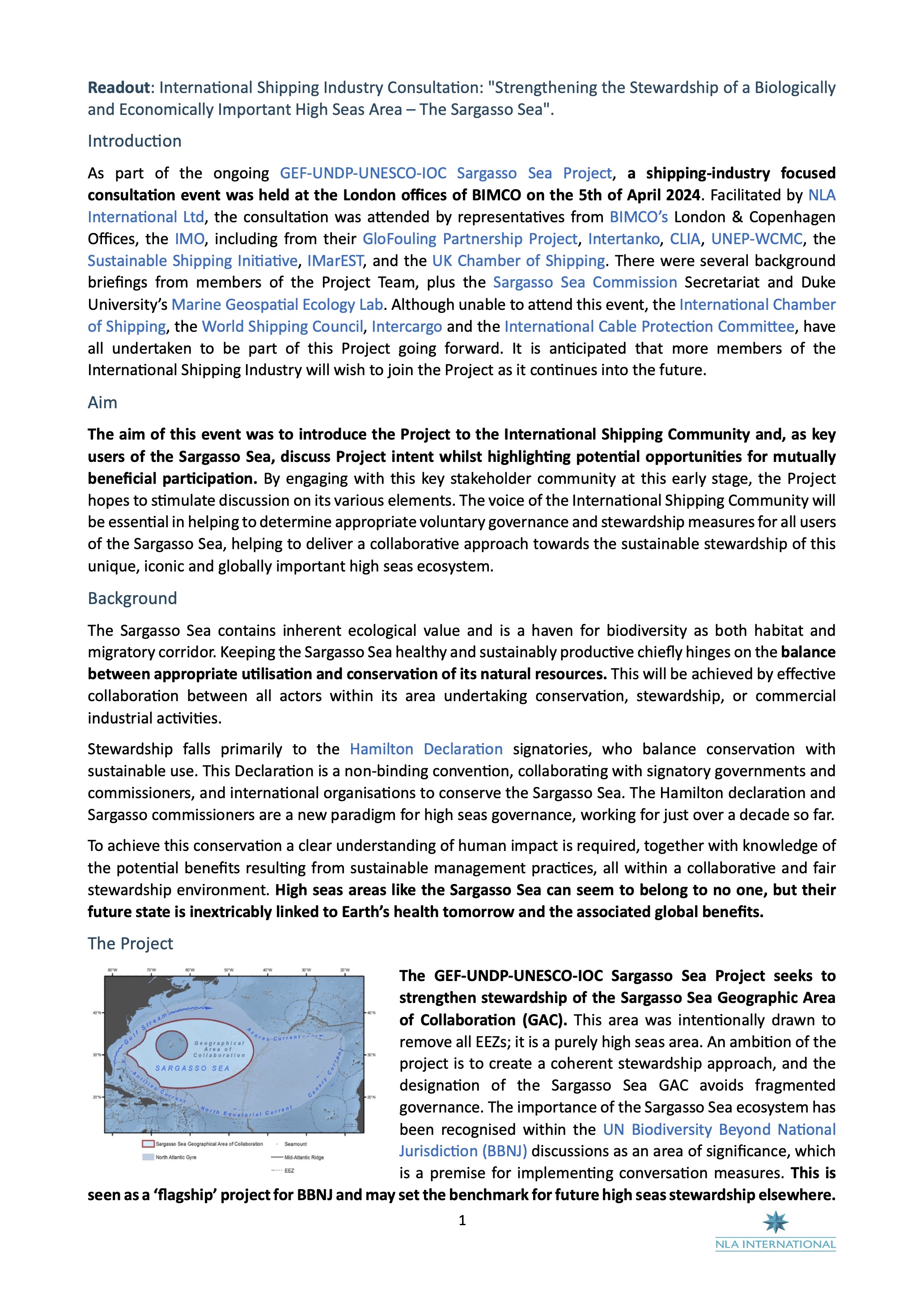
 On April 5th, 2024, NLA International and BIMCO co-hosted a stakeholder engagement workshop for members of the Sargasso Sea shipping community at BIMCO offices in London. This meeting was attended by representatives from IMO, IMO's GloFouling partnership, Intertanko, CLIA, UNEP-WCMC, the Sustainable Shipping Initiative, IMarEST, and the UK Chamber of Shipping, with several other stakeholders supporting the initiative but unable to attend.
The aim of this event was to introduce the Global Environment Facility UNDP-IOC Sargasso Sea Project, a child project of the Common Oceans Programme, to the International Shipping Community and, as key users of the Sargasso Sea, discuss Project intent whilst highlighting potential opportunities for mutually beneficial participation.
Click here to access the full meeting readout or click on the read more below for main takeaways.
Main takeaways from the workshop included:
- There must be a balance of focus between analysis of the primary high seas area, and its internal connectivity, and the inclusion of the areas and nations most environmentally and economically connected to it.
- Participation and buy-in from the full stakeholder community is crucial.
- The science for analysis on the Sargasso Sea is unevenly mature and unevenly distributed. The industry view was that there will be unknowns regarding the impacts of shipping on aspects of marine biodiversity. A weight of evidence approach may be useful here.
- The SAP should not only look at addressing problems identified by the SEDA, but also on realising opportunities that enhance the lasting environmental and socio-economic value of the Sargasso Sea GAC.
- The Sargasso Sea project is a flagship for BBNJ. What is demonstrated in the Project should be translatable and scalable to future BBNJ initiatives.
- Leadership should be shared and co-owned by the stakeholder community, enabling all involved to take the lead in the development of voluntary measures.
- The participation of both the Guardians and the Users of the sea space in data collection, sharing, analysis, and potentially co-financing, will be necessary to meet data challenges in the Sargasso Sea.
- There are already many ships of opportunity participating in ecosystem data collection on the high seas. In many cases these initiatives relieve bordeom during transit for crews. Limitations in citizen science, and methods to mitigate them were discussed.
- Openly sharing data on environmental protection, safety and security is possible but challenges of data sensitivity and sharing must be addressed to make these available. Clarity is needed to share data effectively at scale. In addition, there are other considerations, including the cost of collecting data to ship owners, and legal issues in sharing it. Most importantly, there is a lack of clarity as to derived benefits of data and these must be better articulated. It was noted that the project may benefit from a data and information management strategy.
- Participation in voluntary conservation activities may benefit the industry by fulfilling ESG guidelines.
- While it was too early in the process to identify area based management tools to be put in place, discussion focused on if the instruments would be novel or traditional, mandatory or volunary, and how their costs would be borne. PSSAs and MPAs were briefly discussed.
- More detail was given on PSSAs - their designation in the high seas was possible, and they are designed to balance envrionmental protection with the needs of international shipping.
- Voluntary measures are already an established approach in some areas, for example regarding vessel speeds to minimise whale strikes. It was difficult to maintain an overview of voluntary measures to make sure all parties remained informed of them, however.
- Considering that this Project may inform BBNJ implementation, a view to coherence from the start may be beneficial, articulating voluntary measures that may be consistently replicated elsewhere if appropriate.
- There will certainly be costs for implementation and monitoring and incentives may be key to encouraging wide uptake of voluntary measures. Protection of the Sargasso Sea may be achieved through regulatory means, with enforcement and compliance, or via voluntary measures with incentives.